
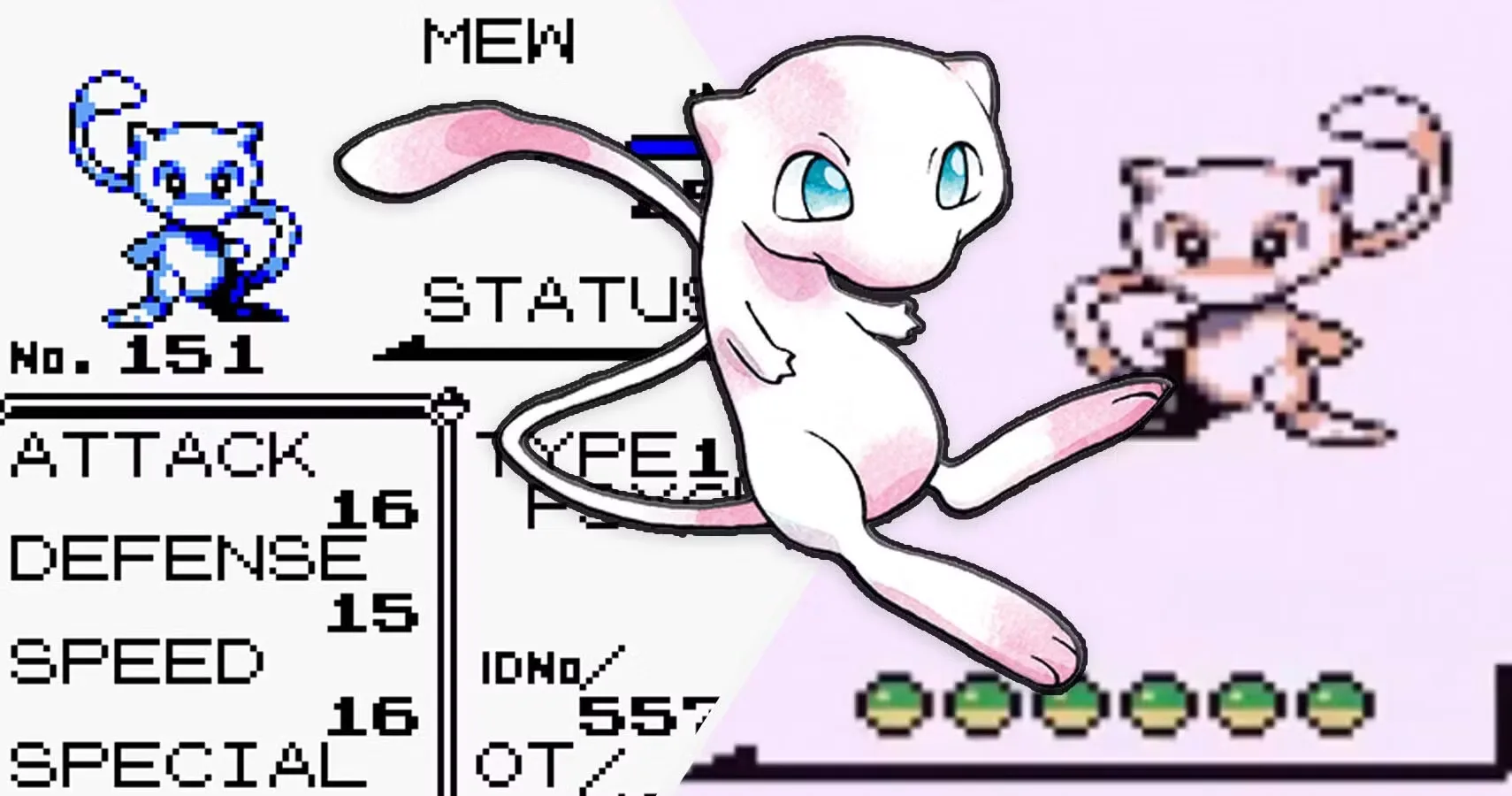
In the wake of Pokémon Red and Green’s Japanese debut in 1996, an intriguing whisper began to spread among players: rumors of a mysterious 151st Pokémon. With the in-game Pokédex seemingly complete at 150 entries, there was little reason to believe in the existence of another creature. However, as scattered reports of encounters with “Mew,” a mythical Pokémon, began to surface and gain traction, the impossible started to feel real.
The emergence of a widely recognized glitch that seemingly allowed players to encounter Mew fueled widespread speculation about its authenticity. The mere possibility of Mew’s existence ignited a frenzy of controversies and led to the proliferation of countless false methods to obtain it. Eventually, the developers themselves acknowledged and confirmed that Pokémon number 151 did, in fact, exist. What was largely unknown to Nintendo at the time was that programmers had discreetly slipped Mew into the games during their final development stages. Initially intended to remain a closely guarded secret, Mew’s accidental revelation profoundly accelerated Pokémon’s success, becoming an unforeseen catalyst for the franchise’s meteoric rise to popularity.
- Play Pokémon Red on your Android device with a simple APK.
- Play Pokémon Blue on your Android device with a simple APK.
Mew’s Haphazard Origin Story

Pokémon Red and Green, the pioneering titles in the now-legendary series, were developed by Game Freak and published by Nintendo. The fascinating details of Mew’s clandestine origins were later brought to light through an interview with The Pokémon Company president and CEO Tsunekazu Ishihara and Game Freak programmer Shigeki Morimoto. The developers faced a significant challenge in fitting their ambitious game onto the limited space of Game Boy cartridges. To maximize space, they systematically removed debug features once the game’s core development was complete. This meticulous process inadvertently freed up a tiny, but crucial, 300 bytes of space – an amount equivalent to little more than four lines of text.
Standard programming protocol dictates that once the debugging process is finalized, the code should remain untouched. However, Morimoto, fueled by a playful impulse, defied this convention. Knowing this minute pocket of space was available, he secretly snuck in the cat-like Pokémon he had created, Mew. Despite the game having just undergone a rigorous debugging process, Mew’s surreptitious addition carried the potential to influence the existing game code – a risk that ultimately proved true. Morimoto later recounted this act as a secret and harmless prank, one that even Ishihara was quietly aware of. Crucially, as Morimoto intended, players were never meant to be able to access Mew through normal gameplay means.
As whispers of this elusive Mew spread, players became obsessed with uncovering the truth, leading to a proliferation of theories on how to find it. One particular urban legend gained immense traction and remains widely remembered today: the belief that Mew was hidden underneath a truck in Vermilion City. Located near the S.S. Anne dock, this truck is typically inaccessible under normal gameplay circumstances. Many players fervently believed that by using the HM ability Surf, they could somehow reach the truck and discover Mew concealed beneath it. Among other imaginative conjectures was the idea of using HM Strength to reveal Mew in a hidden hideout belonging to Team Rocket, the games’ antagonist group. Players diligently pursued these rumored theories, but to no avail. While none of these speculated methods for finding Mew were accurate in the original games, their very existence kept the mystery and allure of Mew alive, fueling the burgeoning Pokémon community.
Mew Was a Viral ’90s Mystery

As the talk of Mew escalated into a widespread phenomenon, it became impossible for the developers to ignore the fervent speculation about Pokémon 151’s existence. Consequently, an official announcement for the Legendary Pokémon Offer was made in April 1996. This groundbreaking campaign, featured in CoroCoro Comic (a popular manga magazine in Japan), invited fans to submit a postcard application for a chance to obtain their very own Mew. Out of approximately 78,000 entries, only a fortunate 20 individuals were selected as winners.
These lucky winners received their Mew by sending their game cartridges directly to Shigeki Morimoto himself. Using his personal computer and a Game Link Cable, Morimoto meticulously traded the Mews he had generated onto their copies. Each Mew was uniquely coded with its own Original Trainer (OT) and Trainer ID, ensuring its distinctiveness. The distribution of these exceedingly rare Mews marked the most exclusive and, significantly, the first official Pokémon event in history. Given the limitations of the original Game Boy cartridges – whose save data would often become corrupted or erased once their internal batteries eventually died – it remains unconfirmed whether any of these original 20 Mews are still present on working cartridges today. The lifespan of these cartridges depended on various factors such as storage conditions and total gameplay time. While estimates vary, the chances of someone possessing an authentic, functional Mew from this original event today are exceedingly slim.
Before players began inadvertently stumbling upon Mew through glitches, Pokémon Red and Green’s initial sales were surprisingly underwhelming. The ambitious development of Pokémon had spanned six years, beginning in 1990. As the game neared completion, concerns arose about the Game Boy console becoming outdated, having been released in 1989. Compounding these worries, the games unfortunately missed the crucial end-of-year sales season, typically considered the peak period for retail. Instead, Pokémon Red and Green were reluctantly released in February 1996, historically one of the lowest months for game sales. Ishihara candidly recalled a quiet start upon release, and as feared, sales in Japan were initially much slower than hoped. Despite his confidence in the games’ inherent quality, Ishihara questioned if they had “missed the last train of opportunity” due to the unfortunate release timing – that is, until the sudden and dramatic shift in sales.
The Mew Glitch Saved Pokémon

The unforeseen bug that inadvertently revealed Mew to players quickly ignited a fervor within the community. As fans eagerly caught wind of the “Mew glitch,” the mounting pressure to address the circulating rumors became undeniable. The subsequent announcement of the Legendary Pokémon Offer coincided directly with a remarkable surge in sales. Around this pivotal time, Ishihara revealed that weekly sales began to match their previous monthly sales figures, a clear indication of Mew’s impact. Sales continued to climb, eventually reaching four times their initial rate. It wasn’t until more than a year and a half after its initial release that Pokémon Red and Green ascended to become the best-selling game in Japan. It was this monumental domestic success that paved the way for Pokémon’s international expansion, leading to the highly anticipated release of Pokémon Red and Blue in 1998 in Western markets.
Following this international success, promotions akin to the Legendary Pokémon Offer were held in regions outside Japan to gift lucky players their very own Mew. At some of these events, players even received a special certificate or a sticker applied directly to their game cartridges alongside their newly acquired Mew, serving as official proof of its authenticity.
Over 26 years later, the original Pokémon games proudly stand as the franchise’s best-selling video game titles, boasting an impressive 31.38 million units sold worldwide. The Pokémon Company’s dominance has since expanded far beyond video games, encompassing multimedia empire that includes new games, blockbuster movies, a thriving trading card game, and much more. The Pokémon series continues its steady stream of releases, most recently with Pokémon Scarlet and Violet in 2022. Despite Pokémon’s vast evolution, developers still subtly remind the community of Mew’s preceding impact through various Easter eggs in recent games. For instance, in Pokémon FireRed and LeafGreen, developers strategically placed an invisible Lava Cookie by the infamous truck where Mew was once rumored to be hiding. Similarly, players can find a Revive, another nostalgic Easter egg, by the same truck in Pokémon: Let’s Go, Pikachu! and Let’s Go, Eevee!. Furthermore, the popular mobile game Pokémon Go recently celebrated its seventh anniversary by featuring a Shiny Mew, allowing players to purchase an exclusive “All-in-One #151” Masterwork Research ticket to complete challenging tasks in exchange for rewards, including the coveted Shiny Mew.
Over two and a half decades later, Mew remains an incredibly meaningful and iconic part of the Pokémon universe. Though it began as a mere secret and a playful prank conceived by a select few on the Game Freak team, it unexpectedly propelled the trajectory of Pokémon’s reign skyward. While slipping a Pokémon into a game without Nintendo’s express knowledge is certainly not a stunt Morimoto would consider nowadays, Mew’s profound and lasting impact is undeniable. As Ishihara himself acknowledged, without Mew captivating the public imagination, Pokémon might not stand today as one of the most powerful and successful video game franchises in the entire world.
Conclusion: The Undeniable Power of a Secret
Over two and a half decades later, Mew remains an incredibly meaningful and iconic part of the Pokémon universe. Though it began as a mere secret and a playful prank conceived by a select few on the Game Freak team, it unexpectedly propelled the trajectory of Pokémon’s reign skyward. While slipping a Pokémon into a game without Nintendo’s express knowledge is certainly not a stunt Morimoto would consider nowadays, Mew’s profound and lasting impact is undeniable. As Ishihara himself acknowledged, without Mew captivating the public imagination, Pokémon might not stand today as one of the most powerful and successful video game franchises in the entire world.
- Play Pokémon Red on your Android device with a simple APK.
- Play Pokémon Blue on your Android device with a simple APK.
RELATED ARTICLE :
Ultimate Guide to Cloning Items in Pokémon Red, Blue, and Yellow


 Security verified